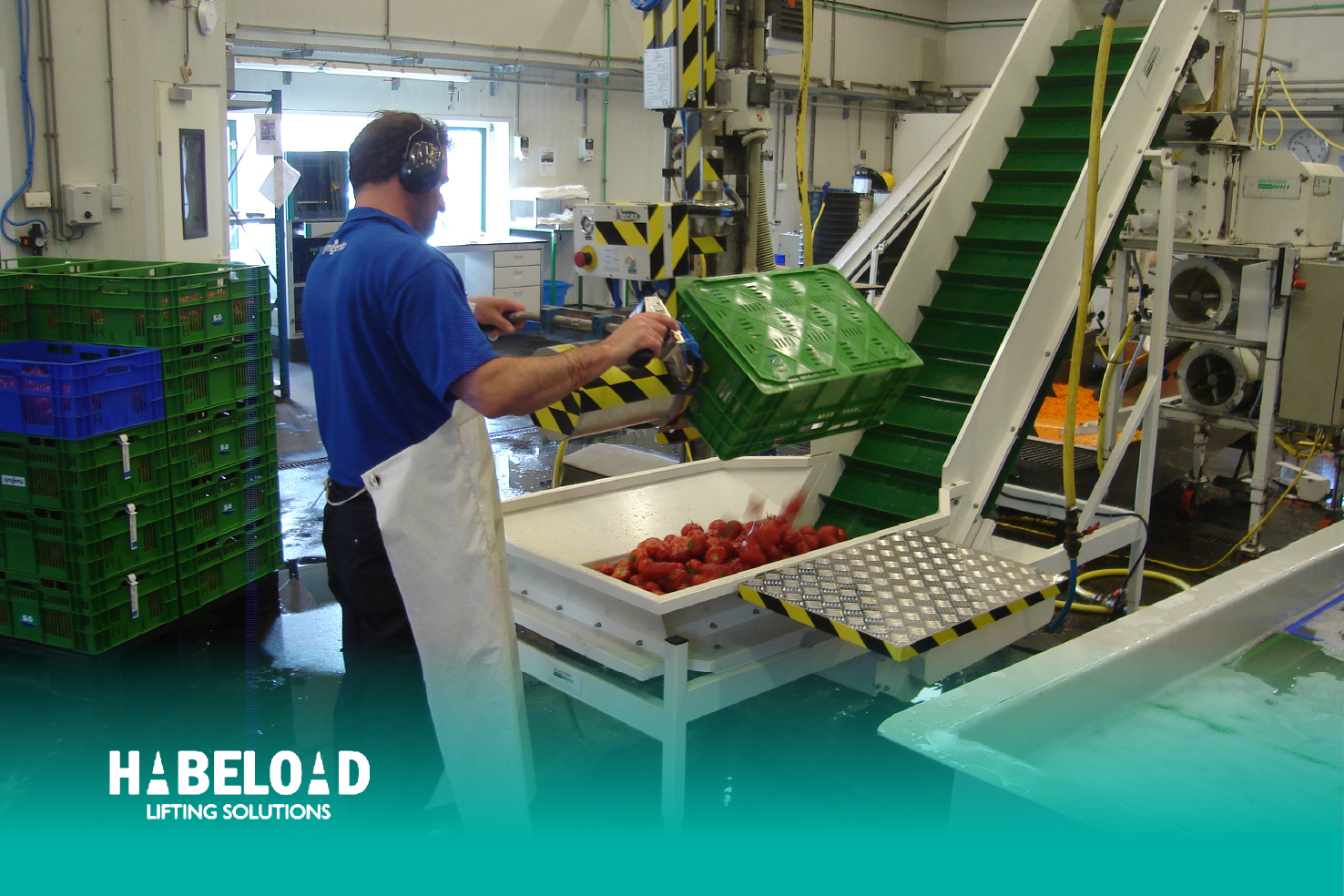
Boxes and crates seem like simple items to move. Yet, in many warehouses, distribution centers, and production environments, these tasks are among the most common sources of physical strain. Because employees perform these tasks daily, the impact is often underestimated. The combination of weight, frequency, and repetition can lead to physical complaints, lost time, and a less efficient process. The question, therefore, is not just how to move boxes and crates safely, but how to do so in a way that keeps employees healthy and contributes to higher productivity.
Many companies focus on heavy products when addressing physical strain, while lighter loads can actually cause problems.
Why is that?
Because boxes and crates:
It is precisely this repetition that increases the risk. According to TNO, physical strain can be caused by lifting, carrying, repetitive movements, and awkward working postures.
Ergonomic lifting means that an employee experiences as little physical strain as possible while performing their tasks.
Key principles include:
In practice, however, good lifting technique alone is not always enough.
A lifting task becomes inefficient when employees:
That might seem like a small difference, but when a task is performed hundreds of times a day, the time lost adds up quickly.
That is why more and more companies are looking not only at safety, but also at efficiency.
When boxes and crates are processed regularly, a lifting aid can help reduce both physical strain and the number of manual operations.
A lifting solution can contribute to:
In addition, an ergonomically designed process often ensures greater uniformity in how tasks are performed.
Do you recognize one or more of the situations below?
Physical complaints are often the first sign that the workload is becoming too high.
Every extra step costs time and energy.
This increases the risk of awkward working postures.
This limits flexibility and capacity.
This may indicate that a process has been set up in an unnecessarily strenuous way.
There is sometimes a misconception that ergonomics is primarily about comfort.
In reality, ergonomics and productivity have a lot in common.
An employee who:
can often perform tasks for longer, more consistently, and more efficiently.
That is why many companies today are looking not only at reducing risks, but also at ways to design work processes more intelligently.
Do you want to quickly assess whether there is room for improvement?
Then ask yourself the following questions:
The more often you answer "yes," the more likely it is that an ergonomic improvement or lifting solution could be beneficial.
Boxes and crates may seem like simple products to move, but it is precisely the combination of weight, frequency, and repetition that makes these tasks physically demanding.
By taking a critical look at working heights, walking distances, work methods, and tools, organizations can improve both safety and productivity.
The question is therefore not just:
How do we lift boxes and crates safely?
But also:
How do we ensure that employees can continue to perform this work healthily and efficiently for years to come?



.png)
