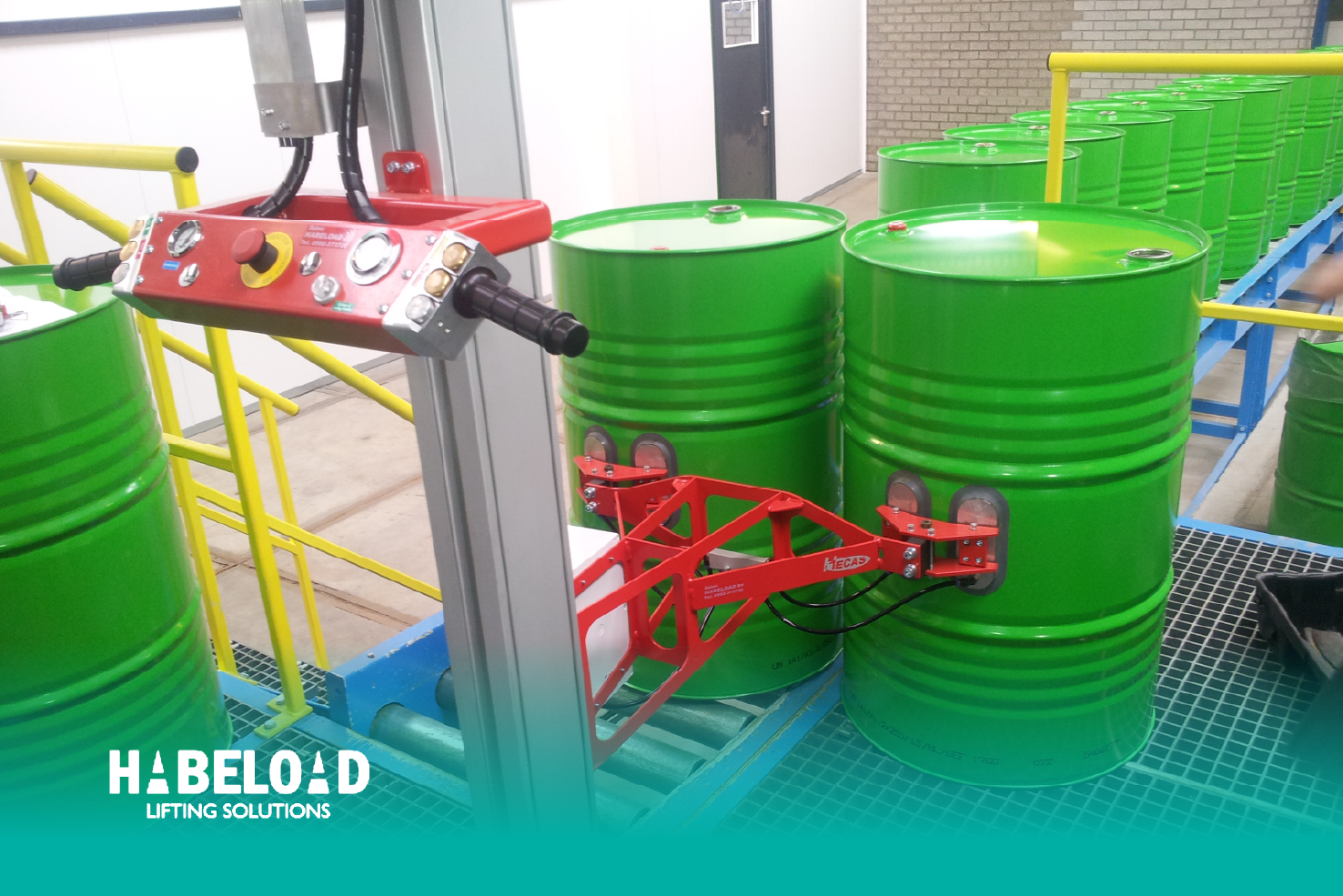
The best way to move a drum or barrel depends on its weight, material, contents, and the specific process requirements. Does the drum only need to be transported, or does it also need to be tilted, emptied, or precisely positioned? Answering these questions first will clarify which method or lifting solution is safe and efficient for your application.
In many production environments, drums and barrels are moved daily. Sometimes they contain raw materials, other times semi-finished products or liquids that are part of the production process. Yet, drums are among the most difficult products to move manually.
They are often:
As a result, moving drums poses risks not only to employees but also to products, processes, and the surrounding environment.
A box usually offers a good grip and a predictable center of gravity. Drums are a different story.
Common challenges include:
This increases the risk of physical strain and unsafe situations. According to health and safety guidelines, lifting, carrying, and awkward working postures can lead to health issues and back problems.
Many companies have become accustomed to their way of working. That does not automatically mean it is the best way.
Manual drum handling frequently involves the following risks:
The back, shoulders, and arms are particularly heavily burdened. Prolonged exposure to physical strain can lead to health issues and absenteeism. Both the Arboportaal and TNO emphasize the importance of limiting physical overexertion in the workplace. Read more about what manual lifting really costs your organization.
A falling or tipping drum can lead to:
When two employees are needed for a single task or when positioning a drum is time-consuming, it comes at the expense of available capacity.
Many organizations think of weight first. That is logical, but weight is often not the most important factor. At least as important are:
These exact factors determine which method is the most efficient.
Good lifting techniques remain important. Consider:
However, when tasks are repeated frequently, technique alone is usually not enough. According to TNO, it is not just the weight of a load that plays a role, but also the frequency, posture, and duration of the strain. That is why more and more organizations are looking for ways to structurally reduce physical strain. View the various lifting systems for industrial applications.
Do you recognize one or more of the situations below?
Then it makes sense to re-evaluate your handling process.
Working safely is important. But the most effective solutions often improve multiple aspects at once:
This not only creates a safer workplace, but often a more efficient production process as well.
The best way to move drums and barrels is not the same for every organization. What works in a warehouse does not necessarily work in a food processing plant or production environment.
That is why a good solution always starts with the question:
What tasks do employees perform today and where is the greatest strain?
Only then does it become clear which approach best suits the situation. Also read which lifting aid best suits your application.
Drums and barrels are among the most challenging products to move manually. Weight, shape, contents, and frequency mean that physical strain and inefficiency can easily occur. By taking a critical look at work methods, postures, and process design, organizations can not only work more safely, but also increase productivity and reduce physical strain.
The question is therefore not just:
How do we move a drum?
But above all:
How do we move a drum safely, efficiently, and in a future-proof way?