Many manufacturing companies face the same challenge: products that are difficult, unstable, or awkward to handle. These situations are often resolved by deploying extra staff, but that is not always the most efficient or future-proof solution. Habeload recently received a similar request. A client was looking for a safe and reliable way to remove unstable fencing from a coating line, tilt it, and then place it onto pallets. The existing method required significant physical effort and multiple operators.
Handling large fencing panels presents specific challenges.
Consider:
When such products are moved manually, multiple employees are often needed to carry out the process safely.
To solve this challenge, Habeload worked with LiftingPlus BV and Goudsmit Magnetics Group to develop a special gripper specifically designed for this application.
The gripper picks up the fencing from the coating line, tilts it in a controlled manner, and then places it onto a pallet. As a result, the entire handling process is supported by one integrated solution.
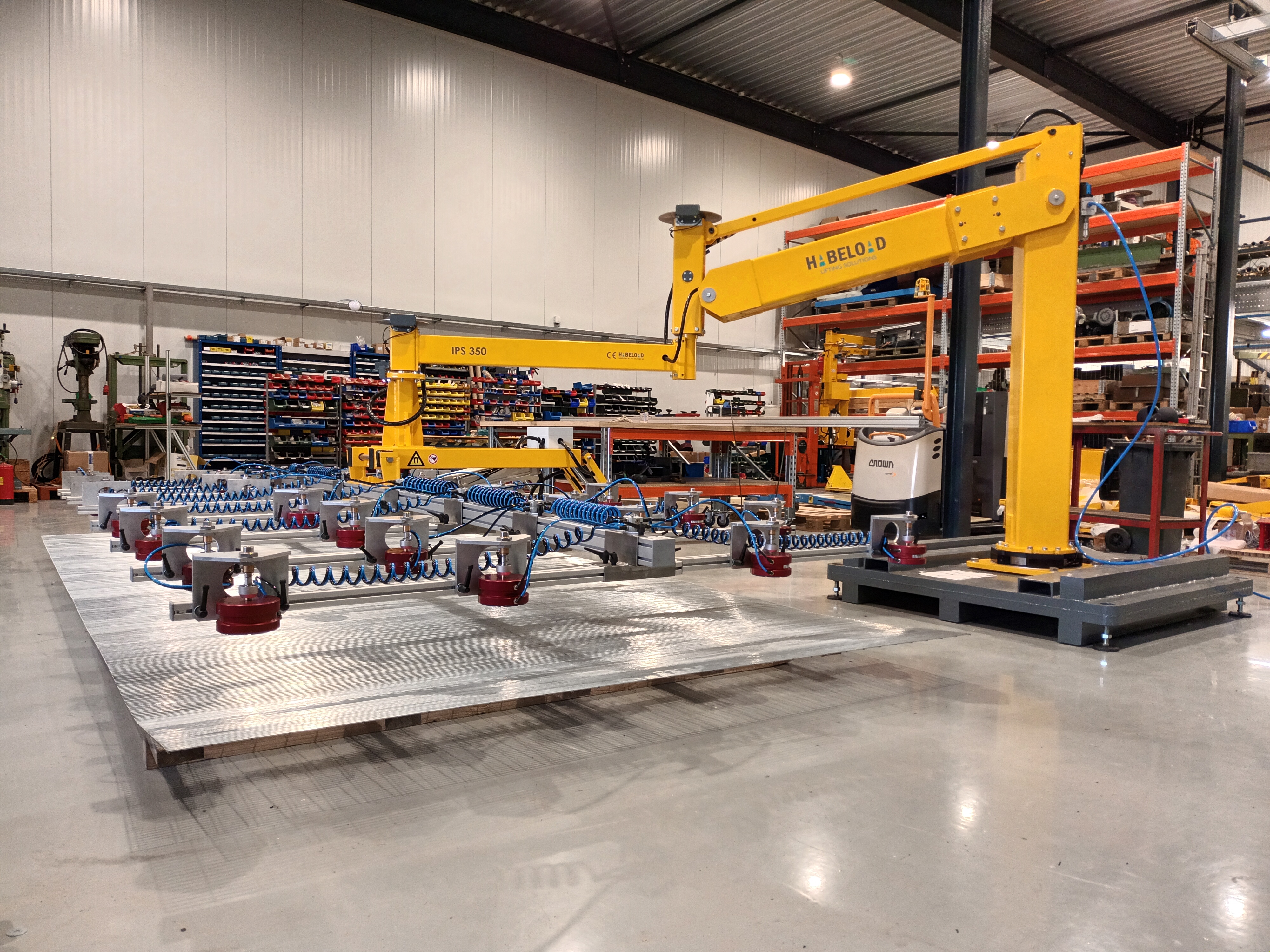
The custom gripper was mounted onto a standard Habeload IPS 350 manipulator. This created a combination of a proven lifting system with a gripper specific to this application.
This demonstrates that not every handling challenge requires a fully bespoke solution. In many situations, a standard lifting system can be combined with a product-specific gripper.
The new solution resulted in a clear improvement of the process.
Where the fences were previously moved by four operators, the work is now carried out by a single operator.
This provides benefits such as:
This case shows that process improvement does not always start with automation.
Often, the biggest gains come from smarter support for existing tasks.
Especially with:
a smart lifting solution can make a significant difference.
Every handling challenge is different. Yet, a good solution often starts with the same question:
For this application, this resulted in a custom gripper combined with an IPS 350 manipulator. A solution that allows a process previously requiring four operators to now be performed by just one.